
Portrait of a Performance
Sarah Snook's tour de force in Kip Williams’ radical reimagining of Dorian Gray

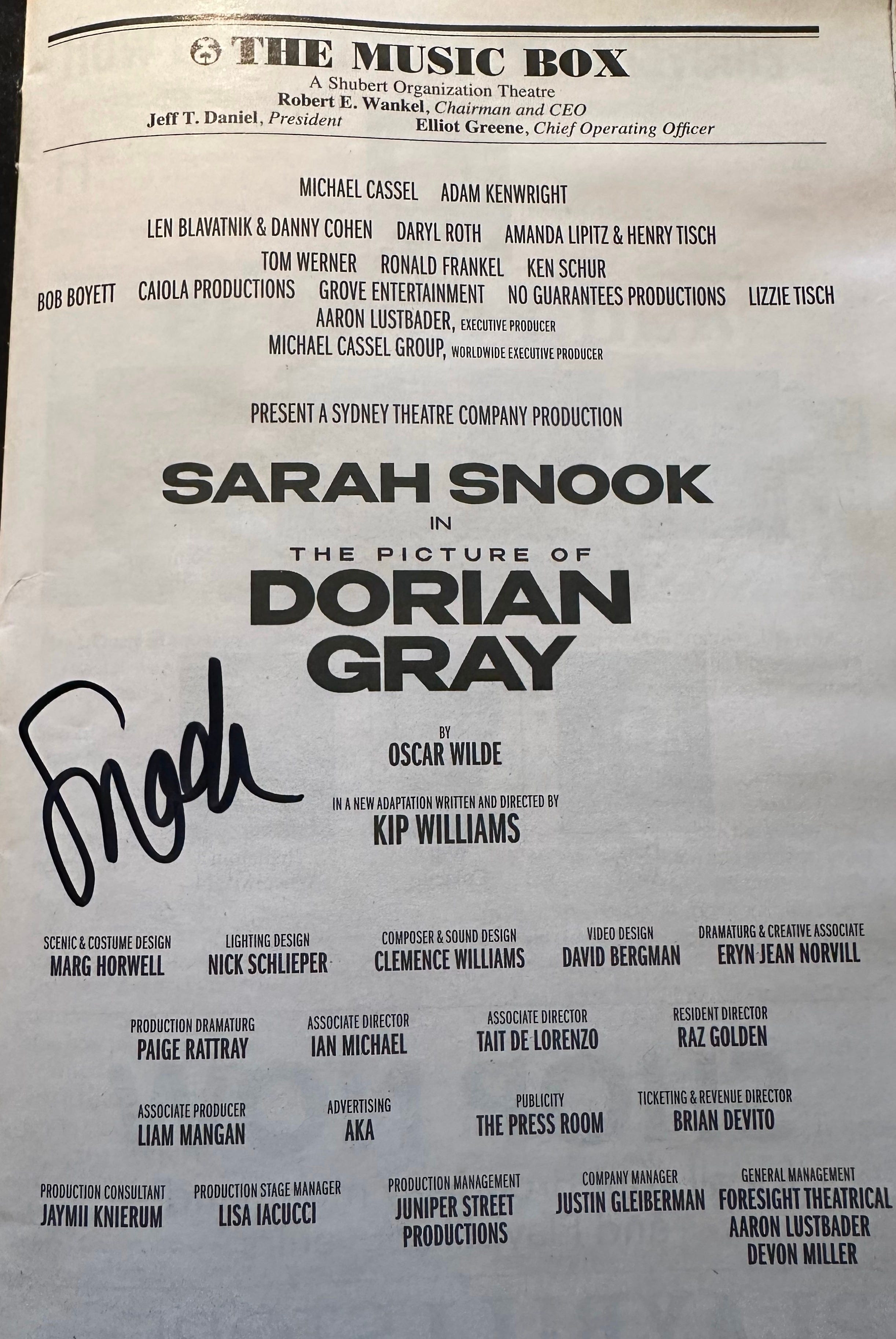
A fabulous US trip ended on a high note. After three weeks of canyons, cities and island escapes, we arrived in New York to see Sarah Snook in The Picture of Dorian Gray on Broadway. The show had just earned her a Tony Award, theatre’s highest accolade, following the Olivier she received in London. The stakes were high. So were our expectations. And yes, the tickets were expensive. But the performance? Worth every cent.
This is a tour de force.
We took our seats in the stalls at the Music Box Theatre and faced a bare black stage. A five-metre screen hung from the ceiling. A lone camera dolly sat in front of a black brick wall. Lighting gantries were exposed. Dozens of coloured floor marks dotted the stage. Within minutes, this stark space would be filled with five mobile videographers, five overhead screens and more than two dozen characters. Played by one actor.
This techno-set contrasted with the ornate theatre surrounds of the Music Box. When it opened in 1921, the New York Times described the Music Box as the “sort of place that reminds people of how theatre once was”.
Though the story may be older than the theatre, this production of Dorian Gray marks not what theatre once was but what it is when reimagined.
The Kip Williams directed/Sarah Snook performance of Dorian Gray is an iconic piece of modern theatre that transforms, transcends and tells in radical ways a shocking story of vanity, deceit and moral decay.
The Picture of Dorian Gray is Gothic tragedy with comedic edges. It is a story of a beautiful young man descending into debauchery and murder, delivered with wit, timing and satire that brings laugh-out-loud moments from the audience. Dorian sits for a portrait by artist Basil Hallward. Lord Henry Wotton is introduced, an English gentleman of wit and wealth. Lord Henry and Dorian strike up a deep friendship but at the same time Dorian makes a pact with a devil: let the portrait age, but let me retain my beauty. “I would give my soul for this.” The bargain is struck.
This is a completely physical, emotional, verbal and non-verbal delivery by Snook - in her eyes, in her wildly shifting expressions, in her inflections, foibles, walk and character-specific quirks.
We’ve seen this ability to shift characters done brilliantly before. Heather Mitchell played twenty six roles in RBG: Of Many, One, Suzie Miller’s biography of Ruth Bader Ginsburg.
But Snook’s performance is another level. As she changes voice, accent, stutter, posture and costume (onstage, including wigs, facial hair, shoes and clothes), she moves between videographers, overhead screens and the precise grid of floor marks to hit her next camera angle. These aren’t wide shots. These are millimetre-close lenses that catch every flicker in her eyes, every twitch of her mouth. Just remembering where to go, and when, is a feat of memory.
It is said that Oscar Wilde wanted to be Dorian, was Lord Henry and saw himself as the stuttering Basil. Snook’s portrayal is a living triptych of Wilde’s personas.
It is realised by Kip Williams’ direction, which fuses theatre with live cinema.
Sitting in the audience is like being in a stadium watching a football match. You can see the play, but you see so much more on the big screen. The audience watches Dorian-Henry-Basil-Snook-et al on stage, but also tracks every close up, every shift in expression on the screens above.
This is accentuated in the first part of the play, where Snook is often obscured behind the big video displays. “It’s a better game at the game,” one football code advertised, and we were there to see the Olivier/Tony winner live. To see her play to the audience. She did, in part. But mostly, she was broadcast through the cameras constantly orbiting her.
Perhaps this reflects Dorian’s initial reluctance as a shy young man when Basil first introduces him to Lord Henry. Video portraits of each character glide across the screens, and there’s a sense of wanting to see more of Snook.
It’s a subtle metaphor, mirroring character and staging.
Dorian is only truly revealed once Basil completes the portrait and shows it to both Henry and Dorian. As the story unfolds, Snook comes forward more, playing brilliantly to the room.
Dorian is besotted with Henry, beguiled by his aphorisms and insights into life, and the wit with which he shares them. Williams’ script doesn’t miss these and Snook relishes them, letting them land with precision so that even those unfamiliar with Wilde’s text feel their sting.
This is an actor who is “living life,” to quote Wilde. This is a little girl, as Snook described herself in her Tony acceptance speech, playing with the words of a genius and a brilliant director. Her performance transcends acting. She is a child playing in her own imagination, with no audience. Except there is one.
Any adult who’s watched a child at play - absorbed, joyful, unaware of being observed - knows the magic. For two hours, Snook is completely immersed. She is doing it for the audience. But she is not. She is doing it to be her best. To win a Tony. But she is not. She is doing it because she loves it. For herself, and for us.
This is not a love story. This is a tragedy. But this is theatre that amazes, entertains, astounds and yes, makes you laugh. Because Snook invests everything in what she is doing. And she is doing a lot.
She plays to the audience with wry smiles, the occasional wink and unexpected interactions with herself on screen: the narrator version of Snook who she dismisses mid-line with, “No, I’ve got this. I think it’s better that way.”
Much of the script is drawn directly from Wilde, as Williams did with The Strange Case of Dr Jekyll and Mr Hyde at the 2023 Perth Festival. But here, the text is layered with commentary and Snook’s own wit and banter that rides between her characters and the audience.
The dialogue accelerates as Gray unravels. The delivery is word perfect. The enunciation is faultless. There are no stumbles, no slips. All the while, she is moving precisely between marks, cameras and cues, dodging equipment, hitting lens lines at millimetre distances, performing to both room and screen.
I’d seen this kind of illusion once before, in 1975, at Alice Cooper’s Welcome to My Nightmare live-concert performance. A screen descended. Cooper vanished. A film played. Just as he reached the camera in a graveyard sprint, he burst through the screen in real life. To do that once was unforgettable. Snook does it again and again.
She uses a mobile phone, handed to her by a crew member, to stream a live video feed to the big screens above. She paws the screen and we see an enhanced image of Dorian, impossibly more beautiful. Then, with increasing intensity, she scratches frantically until the image collapses into grotesque distortion.
This is live theatre broadcast. And it is risky. The iPhone rendering lags once, and we miss a beat of Dorian’s descent. But it reminds us this is live. And the technology is still catching up with the human.
The merging of art and technology has been occurring since the Greeks, who engineered their gods to fly and used machines to make fate visible. Williams doesn’t resist the tech wave. He rides it. His methods amplify the story, keeping audiences who might otherwise drift fully engaged, immersed and entertained.
In winning the Tony for Best Performance by an Actress in a Leading Role in a Play, Snook joins Hugh Jackman (Best Actor in a Musical, The Boy from Oz) and Geoffrey Rush (Best Actor in a Play, Exit the King) in a select group of Australians who have received this highest honour. The production also won the Tony for Best Costume Design of a Play — a nod to Marg Horwell’s seamless, often witty transformations that played out in real time.
This is Australia on a Broadway stage: Sydney Theatre Company, Kip Williams, Sarah Snook. Vision. Craft. Audacity. And a performance that won’t be forgotten; one that lives precisely at the intersection of art and technology.
This review is part of Notes from the Intersection - a series exploring how the arts and technology continue to reshape how we think, create and lead.
.
Wow fantastic description JB. The show must have been incredible